
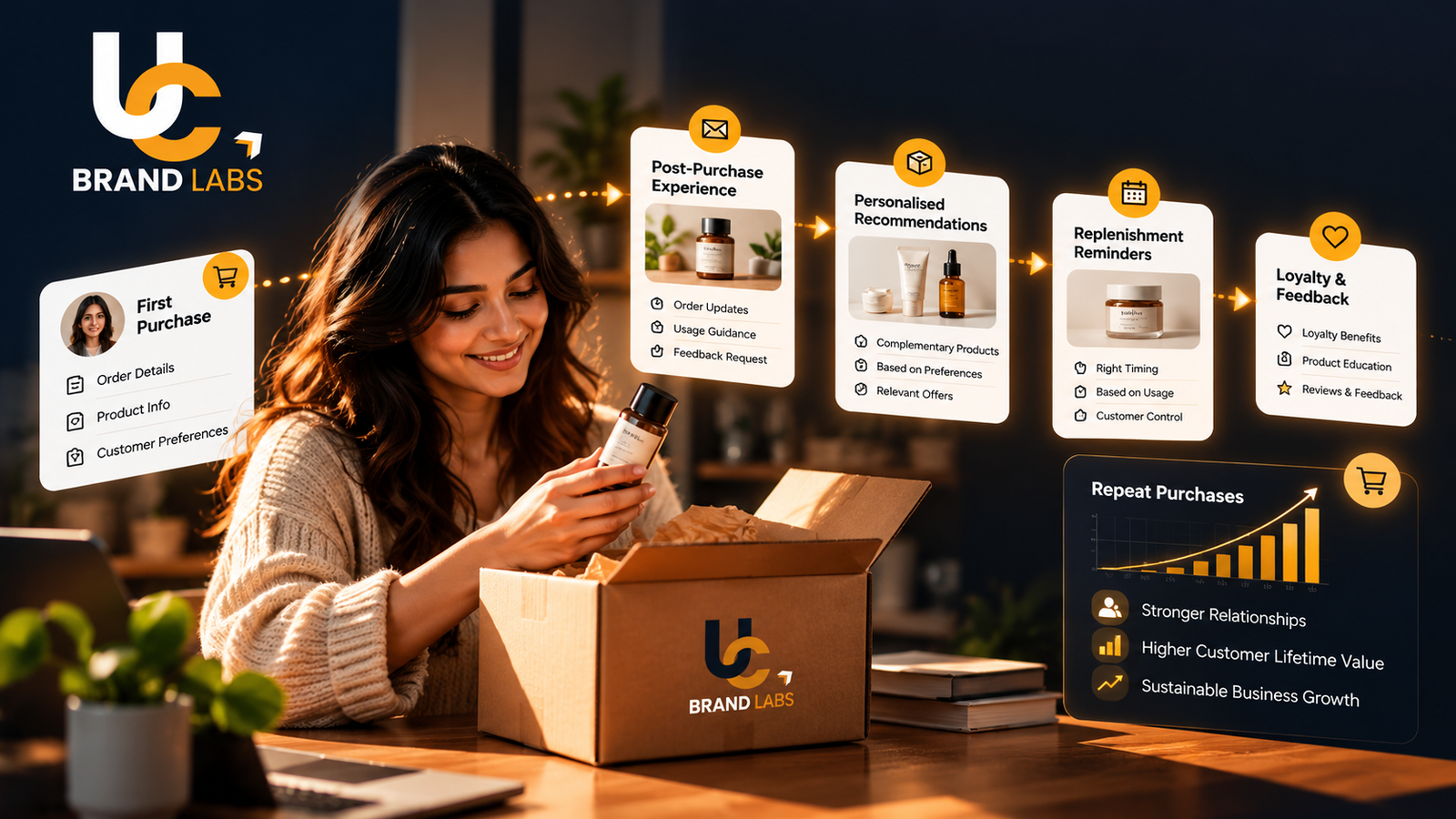
A customer discovers your skincare brand, places an order, and receives the product. Your ecommerce platform records the transaction, your analytics tools capture relevant activity, and your marketing system may store their email preferences.
Then what?
For many D2C brands, the answer is surprisingly little. Customer data sits in disconnected tools, promotional messages go out to everyone, and the next purchase depends on the customer remembering the brand.
Customer data becomes valuable when a brand uses it responsibly to improve the customer experience, encourage relevant repeat purchases, and build long-term relationships—not simply when it collects information.
Here is how D2C businesses can turn the first transaction into the beginning of a stronger customer relationship.
What Customer Data Does a D2C Brand Collect?
First-party data is information a business collects directly through its interactions with customers and visitors. Depending on the systems used and the permissions available, it can include:
- Purchase history: Products purchased, order frequency, and order value.
- Product preferences: Selected sizes, categories, flavours, or other preferences customers share.
- Email and SMS engagement: Whether messages are delivered, opened, clicked, or acted upon, where those events can be measured.
- Website behaviour: Relevant browsing activity, product views, and cart events, subject to applicable privacy requirements and tracking choices.
- Customer feedback: Reviews, survey responses, complaints, and support conversations.
Not all data is collected in the same way. Purchase details may be recorded during checkout, while preferences might be provided through a survey. Browsing behaviour is different from information customers deliberately share.
Brands should collect only information they genuinely need, explain how it will be used, apply appropriate permissions and safeguards, and respect customer choices. More data does not automatically mean better marketing.
Why Customer Data Often Goes to Waste
Collecting information is only the first step. Several problems prevent brands from turning it into useful action.
Disconnected tools: Order history lives in the ecommerce platform, campaign engagement sits in an email tool, and support feedback remains elsewhere. Without a reliable way to connect relevant information, teams struggle to understand the customer journey.
Generic campaigns: Every customer receives the same discount, even when their needs and purchase histories differ.
Missed follow-ups: A customer receives an order confirmation but no useful product guidance, feedback request, or relevant reminder afterward.
Excessive promotions: Repeated discount messages can create fatigue and train customers to wait for offers instead of recognising the product’s value.
The result is a D2C business that knows what customers bought but does little to understand what might make their next interaction better.
How to Turn First-Purchase Data into Repeat Revenue
A practical D2C marketing strategy uses purchase context to make communication more relevant. Consider these approaches.
1. Build a post-purchase journey
Start with helpful communication after the order.
A skincare brand might send product-use instructions after delivery, followed by a feedback request after the customer has had time to try the product. A food brand could share storage guidance or serving ideas.
Promotional messages should not replace essential order updates, and marketing communications should follow the customer’s applicable consent and channel preferences.
2. Recommend relevant products
Purchase history can help identify complementary products.
For example, someone who buys a moisturiser might appreciate information about a compatible cleanser. The recommendation should fit the customer’s likely needs rather than simply promote the highest-priced item.
Useful recommendations improve the shopping experience; irrelevant ones make personalisation feel intrusive.
3. Send replenishment reminders at the right time
Consumable products may have predictable replacement or replenishment cycles, although actual usage varies.
A brand selling coffee, supplements, or personal-care products could test reminders based on purchase date and expected consumption. Give customers control over reminders and avoid implying certainty about when they will run out.
4. Segment customers by behaviour
Not every customer needs the same message. Useful segments might include first-time buyers, repeat customers, customers who have not purchased recently, or customers who regularly buy a particular category.
Start with simple, actionable segments. Avoid creating complicated groups that cannot support a meaningful improvement in communication.
5. Use loyalty and feedback to strengthen relationships
Loyalty benefits, product education, and thoughtful feedback requests can encourage customers to stay engaged. Feedback can also reveal recurring product concerns that marketing alone cannot solve.
For brands refining their broader growth plans, UC Brand Labs’ Marketing & Growth Consulting brings data analysis, audience segmentation, testing, and optimisation into the growth process.
The principle is simple: use customer information to improve relevance, not to send more messages.
The Metrics That Reveal Whether Your Data Is Working
Track outcomes rather than counting messages sent.
| Metric | What It Reveals |
| Repeat purchase rate | The proportion of customers who purchase again within a defined period. |
| Customer retention rate | How effectively a brand retains customers over a specified timeframe, using a clearly defined customer group. |
| Time to second purchase | How long customers typically take to place another order. This can inform reminder timing and customer journeys. |
| Customer lifetime value (CLV/LTV) | The value attributed to a customer over a defined period or estimated relationship. Forecasts depend on assumptions and should be interpreted cautiously. |
| Revenue from returning customers | How much revenue comes from customers who have purchased before. Review this alongside margins and discounts. |
These metrics need context. A product bought monthly has a different repurchase cycle from furniture or occasional-use items. Compare similar customer cohorts and suitable time periods rather than applying a universal benchmark.
Also, an increase in repeat purchases does not automatically prove that a campaign caused it. Seasonality, product quality, pricing, and other factors may influence results.
A Practical Takeaway for D2C Brands
You do not need a complex customer data platform to get started.
Begin with three steps:
- Map the first-purchase journey: Identify what happens between checkout, delivery, product use, feedback, and a possible second order.
- Create one useful post-purchase sequence: For example, send product guidance, request feedback at an appropriate time, and test a relevant follow-up for customers who have agreed to receive marketing.
- Measure the outcome: Track repeat purchases, time to second purchase, and revenue from returning customers. Compare results across suitable customer groups and time periods.
Review the findings, improve the sequence, and expand only when the process is useful to customers and commercially worthwhile.
For Indian D2C brands, responsible data handling should also be part of the plan. The Digital Personal Data Protection Act, 2023, and the Digital Personal Data Protection Rules, 2025, form part of India’s data-protection framework; the notified Rules include a phased enforcement timeline. Brands should verify the provisions and timelines applicable to their activities using the official Ministry of Electronics and Information Technology resources. This is operational guidance, not legal advice.
FAQs
What is first-party data in D2C ecommerce?
First-party data is information a brand collects directly through its own customer interactions, such as purchases, voluntarily shared preferences, feedback, and relevant website activity.
How can D2C brands increase repeat purchases?
Improve the post-purchase experience, provide useful product guidance, recommend relevant products, test replenishment reminders where appropriate, and make loyalty benefits meaningful. Measure results rather than assuming every message drives a sale.
Which metrics help measure customer retention?
Repeat purchase rate, customer retention rate, time to second purchase, revenue from returning customers, and customer lifetime value can help. Define each metric consistently and account for the product’s natural repurchase cycle.
How can customer data improve D2C marketing?
It can help brands segment audiences, tailor relevant communication, improve product recommendations, identify customer friction, and evaluate retention efforts. Its value depends on data quality, responsible use, and whether the insights lead to better customer experiences.
Conclusion: Make the First Purchase the Start of a Relationship
The first transaction gives a D2C brand an opportunity to learn, serve, and build trust. If customer data remains unused, that opportunity fades. If it informs helpful communication, relevant recommendations, and measurable retention efforts, it can support stronger customer relationships and more sustainable growth.
The goal is not to know everything about every customer. It is to use appropriate information thoughtfully, respect customer preferences, and make the next interaction more valuable.
For brands ready to connect customer insights with a broader growth plan, UC Brand Labs offers strategy and growth consulting to help turn data-informed decisions into practical marketing action.
