
Key Takeaways
- What a creative brief is and why campaigns need one.
- How a creative brief aligns teams and reduces unnecessary revisions.
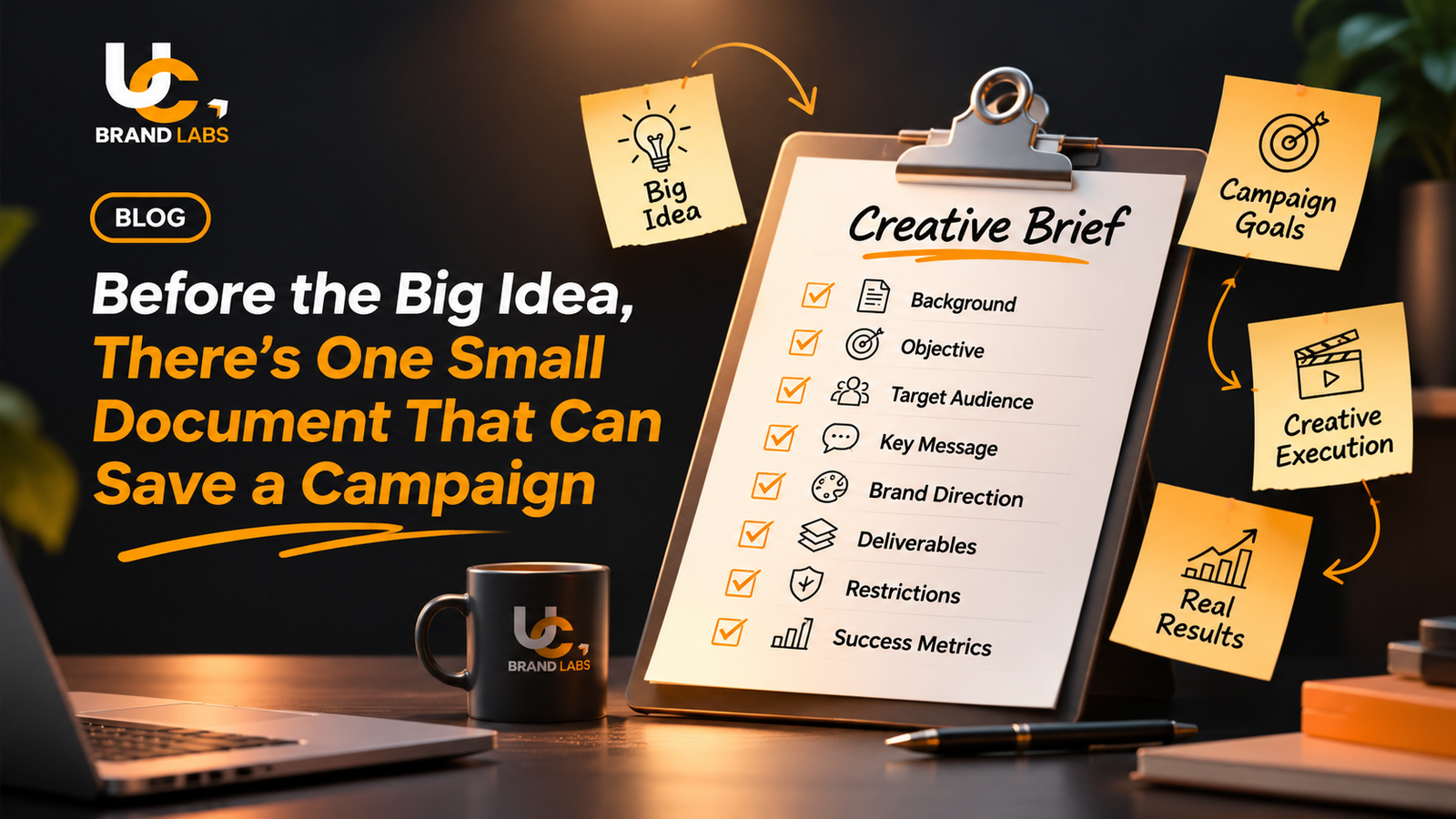
- The nine essential elements: campaign background, objectives, target audience, customer insight, key message, brand direction, deliverables, restrictions and success metrics.
- A practical example of a creative brief for a D2C product launch.
- The difference between a creative brief and campaign strategy.
- Common mistakes brands should avoid while preparing a creative brief.
A campaign idea sounds exciting in a meeting. Someone suggests a catchy tagline, another person imagines a video, and the team starts discussing colours, formats and social media posts.
Everyone is enthusiastic. Work begins.
A few days later, the first designs arrive. The client expected a product-focused campaign, but the creative team has developed a brand-awareness concept. The social media team is working with a different message, and the paid media team is unsure which audience the campaign is supposed to target.
The problem may not be the creative idea. It may be the lack of a clear starting point.
Before the big idea, there is one small document that can make the entire process easier: a creative brief.
For D2C brands, a creative brief helps translate a business objective into clear communication. It gives everyone involved a shared understanding of what the campaign needs to achieve, who it is speaking to and what the audience should take away.
What Is a Creative Brief?
A creative brief is a short document that explains the essential requirements of a marketing or advertising campaign.
It acts as a reference point for the people responsible for developing, producing and executing the campaign.
A typical creative brief includes:
- Campaign background.
- Business or marketing objective.
- Target audience.
- Customer problem or insight.
- Key message.
- Brand tone and communication style.
- Deliverables and platforms.
- Mandatory information and restrictions.
- Timeline and budget, where relevant.
- Success metrics.
The brief does not need to contain every possible detail. Its purpose is to provide enough direction for the team to make informed creative decisions.
Think of it as the connection between what a brand wants to achieve and what the audience eventually sees.
Why Does Every Campaign Need a Creative Brief?
A creative brief may look like an administrative document, but it can influence the quality and consistency of campaign execution.
1. It Gives Everyone the Same Direction
A campaign usually involves several people: marketing managers, designers, copywriters, video editors, media buyers and sometimes external agencies.
Each person may interpret a campaign idea differently.
For example, a D2C skincare brand wants to promote a new sunscreen.
The marketing team wants to communicate sun protection. The creative team focuses on lifestyle visuals. The copywriter highlights product ingredients. The advertising team wants to promote a limited-time offer.
All these directions may be useful, but without a common objective, the campaign can feel disconnected.
A brief clarifies the main message and helps each team contribute towards the same goal.
2. It Prevents Unnecessary Revisions
Imagine a designer creates five social media creatives, only to discover that the campaign was intended for a different audience or platform.
The work may need to be redesigned completely.
A brief can prevent many of these situations by clarifying expectations before production starts.
It should explain:
- What needs to be created.
- Who the creative is for.
- What message must be communicated.
- Which formats are required.
- What information must be included.
- Who will review and approve the work.
This does not eliminate feedback. It makes feedback more focused and reduces avoidable confusion.
3. It Keeps the Audience at the Centre
Sometimes brands begin campaigns by talking about what they want to say rather than what the customer needs to hear.
A creative brief brings the audience into the discussion.
Instead of writing “Promote our new product”, the brief can identify a specific customer problem.
For example:
A home organisation brand wants to promote storage solutions. Its audience may be people living in smaller apartments who struggle to organise limited space.
The campaign can then focus on practical space-saving ideas instead of simply listing product features.
This makes the creative direction more relevant to the audience.
4. It Connects Creativity With Business Objectives
Creative work should be interesting, but it also needs a purpose.
A campaign designed to introduce a new brand will require a different message from one designed to generate purchases.
A creative brief makes this distinction clear.
| Campaign objective | Creative direction |
| Brand awareness | Introduce the brand and its key difference |
| Product launch | Explain the new product and its benefits |
| Website traffic | Encourage relevant audiences to explore more |
| Lead generation | Communicate a clear problem and solution |
| Sales | Highlight product value and purchase reasons |
| Customer retention | Encourage existing customers to engage again |
The objective influences the message, format, CTA and performance metrics.
The 9 Essential Elements of a Good Creative Brief
A creative brief does not need to be complicated. It needs to answer the questions that matter.
1. Campaign Background
Start by explaining why the campaign is being created.
Is it a new product launch? A seasonal promotion? A brand repositioning exercise? A campaign to improve awareness?
Give the team enough context to understand the situation.
2. Campaign Objective
Clearly define what the campaign should achieve.
Avoid vague instructions such as “Make the brand popular” or “Create something engaging”.
Instead, specify whether the priority is awareness, website traffic, qualified enquiries, purchases or customer retention.
Where appropriate, include a measurable target and timeframe.
3. Target Audience
Describe the people the campaign needs to reach.
Consider:
- Age group and location, where relevant.
- Interests and preferences.
- Shopping behaviour.
- Customer needs.
- Common questions or objections.
- Familiarity with the product category.
For example, a premium coffee brand targeting first-time specialty coffee buyers may need to explain flavour profiles and brewing methods. Existing coffee enthusiasts may respond better to product origin and preparation details.
4. Customer Insight or Problem
Identify the customer need that makes the campaign relevant.
A useful brief goes beyond describing the audience. It explains what the audience wants, struggles with or values.
For a home fitness brand, the insight might be that some customers want to exercise regularly but have limited time and space.
That insight can guide the campaign’s message and visual direction.
5. Key Message
What is the one thing the audience should remember?
A campaign may communicate several supporting points, but the central message should remain clear.
For example:
“Create a practical workout routine at home, even with limited space.”
The supporting copy can explain product features, convenience and available options.
6. Brand Voice and Visual Direction
Explain how the campaign should feel and sound.
Should it be informative, playful, premium, friendly, bold or reassuring?
Include relevant brand guidelines, colour references, typography, visual examples and communication rules.
This helps maintain brand consistency across different creative formats.
7. Deliverables and Platforms
List exactly what needs to be produced.
For example:
- Two Instagram reels.
- Three static social media creatives.
- One website banner.
- Two paid advertising variations.
- One email campaign.
Mention the required dimensions, formats and platforms where possible.
A creative designed for an Instagram story may not work in the same way as a website banner or email header.
8. Mandatory Information and Restrictions
Identify anything that must be included or avoided.
This could include:
- Product name and pricing.
- Offer terms and validity.
- Website URL or CTA.
- Legal disclaimers.
- Approved product claims.
- Brand guidelines.
- Restricted words or visual elements.
This section is particularly important when a campaign involves promotional claims, regulated categories or specific offer conditions.
9. Timeline and Success Metrics
Include important milestones such as the first draft, feedback deadline, final approval and launch date.
Also define how success will be evaluated.
For example:
- Awareness: reach and impressions.
- Engagement: meaningful interactions.
- Traffic: clicks and landing-page visits.
- Lead generation: qualified enquiries.
- Sales: purchases, CPA and ROAS.
The metrics should reflect the campaign objective rather than simply listing every available platform metric.
Example: A Simple Creative Brief for a D2C Product Launch
Let’s consider a fictional D2C reusable water bottle brand launching a new insulated bottle.
| Brief element | Example |
| Campaign | New insulated bottle launch |
| Objective | Introduce the product and generate product-page visits |
| Target audience | Urban professionals and college students |
| Customer insight | People want a convenient bottle that keeps drinks at their preferred temperature |
| Key message | Temperature convenience for everyday routines |
| Tone | Modern, practical and friendly |
| Deliverables | Two reels, three static creatives and one website banner |
| Platforms | Instagram, Facebook and website |
| CTA | Explore the new bottle |
| Success metrics | Reach, video engagement, link clicks and product-page visits |
This brief gives the team a starting point without dictating every creative decision.
The designer can explore different visual approaches. The copywriter can develop multiple hooks. The advertising team can test different creative variations.
Everyone is working towards the same objective.
Creative Brief vs Campaign Strategy: Are They the Same?
These terms are related, but they serve different purposes.
A campaign strategy defines the broader approach: what the brand wants to achieve, which audience it needs to reach, how it will compete and which channels may support the objective.
A creative brief translates the relevant campaign direction into instructions for creative development and execution.
| Campaign strategy | Creative brief |
| Defines the broader campaign approach | Guides creative development |
| Covers audience, positioning and channel choices | Covers audience, message and deliverables |
| Explains why the campaign is needed | Explains what the creative needs to communicate |
| Supports decision-making | Supports production and execution |
| May cover several campaigns | Usually relates to a specific campaign or creative assignment |
A creative brief should align with the campaign strategy, not replace it.
Common Creative Brief Mistakes
Writing vague objectives: “Increase engagement” does not explain what the campaign needs to achieve or why.
Trying to target everyone: A campaign without a defined audience often produces generic communication.
Adding too much information: A brief should be useful, not a collection of unrelated background documents.
Changing the message midway: Major changes after production begins can affect timelines, budgets and creative consistency.
Ignoring platform requirements: The same creative may need adjustments for different placements and formats.
Confusing instructions with creative control: A brief should provide direction without prescribing every visual or headline. Teams need room to develop ideas.
A Better Campaign Often Starts Before the First Design
A strong campaign is not created only through an attractive visual, a clever headline or a trending video format. It starts with clarity.
When the audience, objective and message are understood, creative teams can spend more time developing useful ideas and less time guessing what the campaign is supposed to achieve.
For growing D2C brands, a creative brief also helps maintain consistency as more people become involved in marketing and campaign execution.
At UC Brand Labs, this connection between brand direction, planning and execution is reflected in our Branding & Positioning and Business Strategy & Planning services.
Before asking, “What should the campaign look like?”, it is worth asking one simpler question:
“Does everyone know what this campaign needs to accomplish?”
Sometimes, that small document makes all the difference.
