
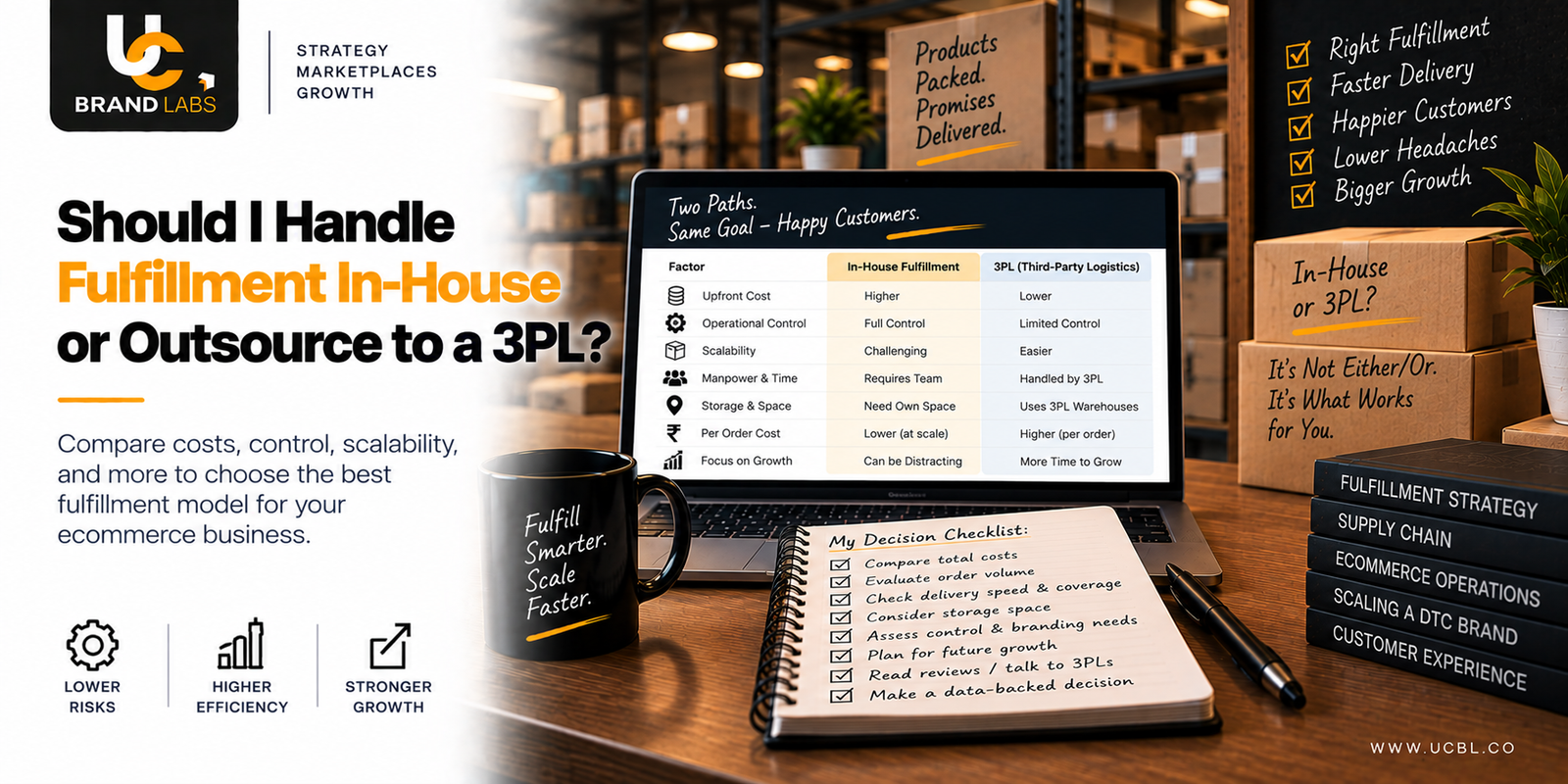
At first, packing your own orders feels simple. Then the orders start growing—and suddenly fulfillment is taking over your business.
Your team is picking products, packing boxes, printing labels, managing inventory, coordinating shipments, and handling returns. What worked for 20 orders a day may become a serious bottleneck at 200 or 500.
That’s when many e-commerce brands start asking:
“Should we keep fulfillment in-house or outsource it to a 3PL?”
There isn’t one answer for every business. The right choice depends on your order volume, product type, margins, warehouse requirements, team, and growth plans.
What Is In-House Fulfillment?
With in-house fulfillment, your business manages the process itself.
This usually includes:
- Storing inventory
- Picking and packing orders
- Managing warehouse staff
- Printing shipping labels
- Coordinating with courier partners
- Processing returns
- Tracking inventory
The biggest advantage is control.
You can control how products are stored, packed, checked, and shipped. This can be particularly useful for businesses selling fragile, customized, or high-value products.
However, as order volume increases, the operational workload increases too.
What Is a 3PL?
A 3PL (third-party logistics provider) handles fulfillment operations on your behalf.
Typically, you send your inventory to the 3PL warehouse, and they manage activities such as:
Storage → Picking → Packing → Shipping → Returns
Instead of building and managing your own fulfillment operation, you pay the 3PL according to its pricing structure.
This can help brands scale without immediately investing in additional warehouse space, staff, equipment, and fulfillment infrastructure.
When Does In-House Fulfillment Make Sense?
In-house fulfillment may work well when:
- Your order volume is still manageable
- You already have warehouse space
- Your team can handle daily fulfillment
- Products require special handling
- You need tight control over packaging
- Your fulfillment process is relatively simple
For a growing brand, keeping fulfillment in-house can also help you understand the operational process before deciding whether outsourcing is necessary.
When Should You Consider a 3PL?
A 3PL can become attractive when fulfillment starts taking too much time or resources.
Consider outsourcing when:
- Order volume is growing quickly
- Warehouse space is becoming limited
- Your team is spending too much time packing orders
- You want to expand into new regions
- You need faster fulfillment
- Managing inventory is becoming difficult
- You don’t want to build a larger logistics operation
The goal isn’t simply to outsource because you’re busy.
The goal is to determine whether a 3PL can deliver the required service at a sustainable cost.
Don’t Compare Only the Per-Order Price
This is where many businesses make the wrong calculation.
You might see:
In-house fulfillment = ₹X per order
and
3PL = ₹Y per order
But your actual in-house cost can include:
- Warehouse rent
- Salaries
- Packaging materials
- Equipment
- Software
- Utilities
- Inventory management
- Shipping coordination
- Returns handling
- Management time
Compare the total cost of fulfillment, not just the packing cost.
Think About Customer Experience Too
Fulfillment isn’t only an operational decision.
It affects the customer experience.
Late dispatches, incorrect products, damaged packaging, poor tracking, and delayed returns can create customer complaints and increase operational costs.
Before choosing a 3PL, evaluate:
- Delivery timelines
- Pin-code coverage
- Order accuracy
- Inventory accuracy
- Technology integration
- Return handling
- Customer support
- Scalability
- Service-level commitments
The cheapest provider isn’t necessarily the right fit if service quality suffers.
Calculate the Break-Even Point
A simple comparison can help.
Calculate your total monthly in-house fulfillment cost.
Then compare it with the estimated monthly 3PL cost at your current order volume.
For example:
In-house: ₹2,00,000/month
3PL: ₹1,60,000/month
If the 3PL provides comparable service and reliability, outsourcing may deserve consideration.
But don’t stop there.
Also consider implementation costs, minimum order commitments, storage charges, technology fees, and other applicable charges.
The Best Choice Can Change as You Grow
You don’t have to choose one model forever.
A brand might start with:
In-house → Hybrid → 3PL
As order volume, geography, and operational complexity change, your fulfillment strategy can change too.
The important thing is to review the numbers regularly rather than staying with a model simply because it’s familiar.
Final Takeaway
The question isn’t simply:
“Is in-house fulfillment cheaper than a 3PL?”
The better question is:
“Which model gives my business the right balance of cost, control, speed, and scalability?”
If your current operation is manageable and gives you a clear cost advantage, staying in-house may make sense.
If fulfillment is becoming a bottleneck and consuming resources that could be used for growth, a 3PL may be worth evaluating.
Choose the model based on your numbers—not just your order volume.
