
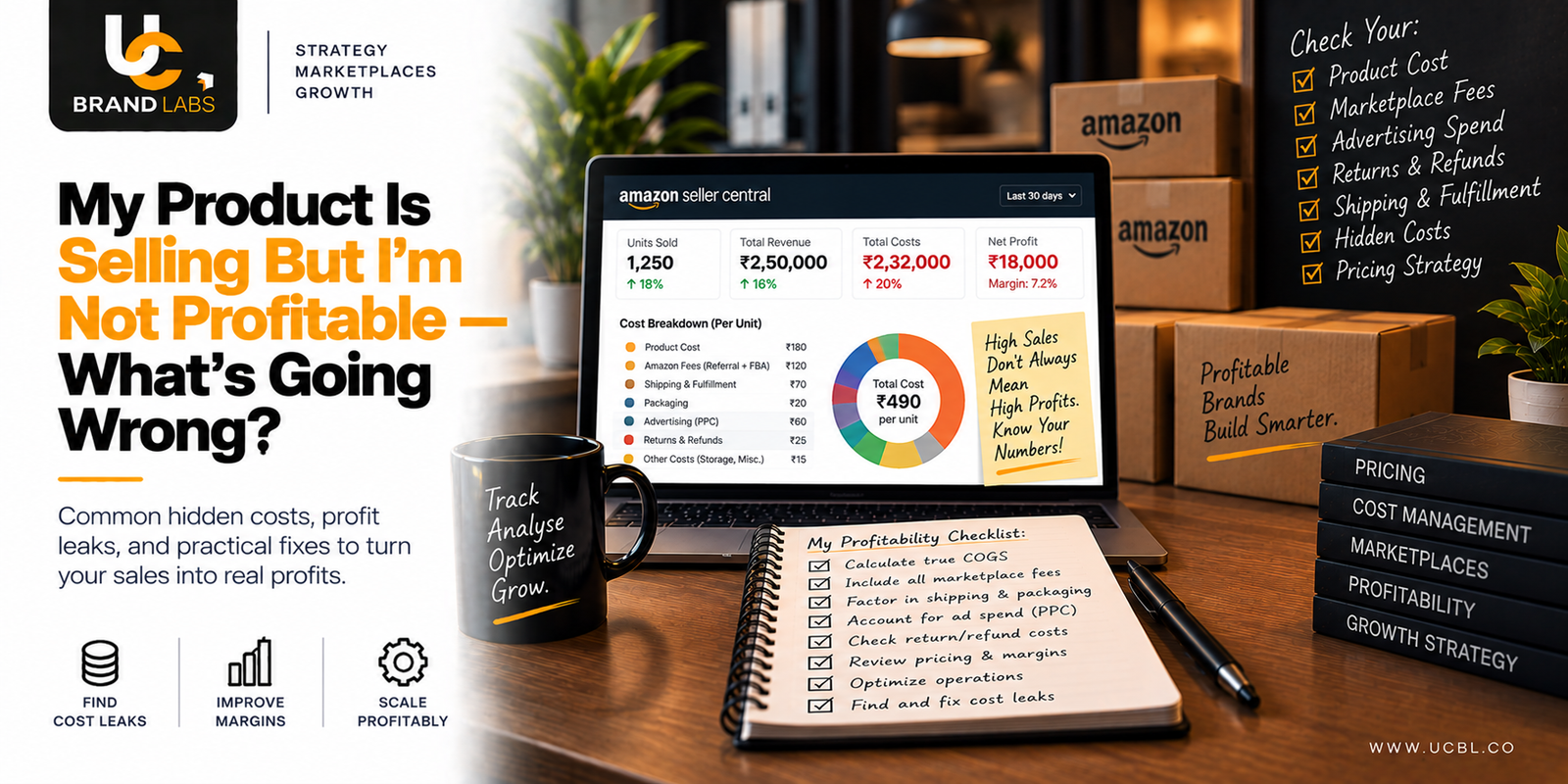
Orders are coming in. Sales are growing. But at the end of the month, where did the profit go?
Your marketplace dashboard looks healthy, yet higher sales aren’t translating into higher profits. It’s one of the most frustrating spots for e-commerce and marketplace sellers, and the instinct is to spend more on ads and chase more orders.
Before you scale, ask a better question: are you making money on every order you sell?
A product can be a best-seller and still be a bad business. Marketplace fees, PPC spend, discounts, shipping, returns, and product costs quietly eat your margin. If profit isn’t growing, the problem may not be sales. It may be your unit economics. This is where marketplace seller consulting often starts: not with more traffic, but with a clear view of per-order profit.
Quick Answer: Why Am I Selling but Not Profitable?
Most sellers who sell well but earn little are losing margin to costs they don’t track per order: marketplace fees, ad spend, discounts, shipping, returns, and storage. Calculate profit per unit for each product after all these costs, then fix the biggest leak before increasing sales volume.
What Are Unit Economics?
Unit economics show how much you earn or lose on a single order after every cost linked to that order. The result is your contribution margin. If it’s thin or negative, more sales just multiply the problem.
Where Your Margin Is Disappearing
1. Product and landed cost
Manufacturing, packaging, inbound freight, and duties all count. Sellers often price against the factory cost instead of the full landed cost.
2. Marketplace fees
Commission, fixed closing fees, shipping fees, and other charges vary by category and platform. Check your latest fee schedule, since these can change.
3. PPC and ad spend
Ads can make a sale look successful while wiping out the margin. A campaign that brings orders at a loss isn’t growth.
4. Discounts and coupons
Every rupee of discount comes straight out of profit. Deals that boost rank can still be unprofitable.
5. Shipping and fulfillment
Weight slabs, packaging, pick-and-pack charges, and delivery zones add up fast, especially on low-priced items.
6. Returns and RTO
Returned or undelivered orders mean lost freight, handling costs, and sometimes unsellable stock.
7. Hidden costs
Storage fees, aged inventory, damaged stock, payment or settlement delays, and taxes are easy to overlook.
A Simple Example (Illustrative Numbers)
This example uses made-up numbers, not benchmarks.
| Item | Per order (₹) |
| Selling price | 1,000 |
| Product cost | 350 |
| Marketplace fees | 200 |
| Shipping and fulfillment | 90 |
| Packaging | 30 |
| Returns allowance | 60 |
| Margin before ads | 270 |
| PPC spend | 150 |
| Profit per order | 120 (12%) |
Now add a ₹100 coupon. If costs stay the same, profit drops to ₹20. Ad spend rises slightly and you’re losing money on every sale.
How to Find Your Real Profit Per Order
- List every cost per SKU: product, fees, shipping, packaging, returns, storage, and ads.
- Calculate contribution margin: selling price minus all variable costs.
- Find your break-even ACoS: margin before ads divided by selling price. In the example, that’s 27%. Spend above it and each ad-driven sale loses money.
- Review by SKU, not by account. One loss-making product can hide behind a profitable one.
- Repeat monthly. Fees, ad costs, and return patterns change.
How to Fix Profitability
Improve pricing. Test small price increases, bundles, or multipacks that raise order value without raising shipping proportionally.
Tighten ad spend. Work backward from your break-even ACoS. Pause keywords that spend without converting, add negative keywords, and treat ROAS optimization as a profit exercise, not just a revenue one. For deeper thinking on this, see our guide to scaling customer acquisition without losing profitability.
Improve your listing. Clear images, accurate titles, and honest descriptions raise conversion and cut returns. Strong Amazon listing optimization lowers the ad spend needed per sale.
Control discounts. Run promotions with a floor price based on contribution margin.
Reduce returns. Fix the causes: unclear size charts, misleading photos, or fragile packaging.
Cut or rework negative-margin SKUs. Drop them, reprice them, or change the pack size.
Lower acquisition costs over time. CAC reduction comes from better targeting and repeat buyers. Our post on why repeat customers drive growth explains why.
Common Mistakes to Avoid
- Scaling ads before fixing margins. More spend on a loss-making product multiplies the loss.
- Judging success by revenue or ROAS alone. ROAS ignores product cost, fees, and returns.
- Ignoring returns until month-end. Track them weekly.
- Copying competitors’ prices. Their cost structure isn’t yours.
- Using account-level averages. Profit lives at the SKU level.
When Does Marketplace Seller Consulting Make Sense?
If you’ve run the numbers and still can’t see where profit is leaking, or you’re unsure which SKUs to scale, an outside view helps. A structured marketplace strategy review covers listing optimization, pricing, ad efficiency, and channel choices, so growth doesn’t come at the cost of margin.
FAQs
What is a good profit margin for a marketplace seller? It depends on the category, price point, and cost structure. Instead of chasing a benchmark, calculate your contribution margin per SKU and set a minimum you’re willing to accept.
Is high sales volume a sign of a healthy business? Not by itself. Volume without positive unit economics can increase losses.
What is break-even ACoS? It’s the highest advertising cost of sale you can afford before an ad-driven order becomes unprofitable. Calculate it as margin before ads divided by selling price.
Should I stop running ads if I’m not profitable? Not necessarily. Reduce waste first: pause non-converting keywords, add negatives, and align bids to your break-even ACoS.
How often should I review unit economics? At least monthly, and whenever fees, prices, or costs change.
Conclusion
Selling more doesn’t guarantee earning more. If your product sells but profit doesn’t follow, trace every cost per order, know your break-even ACoS, and fix the largest leak first. Healthy unit economics make scaling safe, and marketplace seller consulting can help when the numbers don’t add up.
Looking to build or grow a profitable e-commerce or marketplace business? UC Brand Labs helps with D2C brand building, marketplace strategy, performance marketing, and e-commerce growth.
